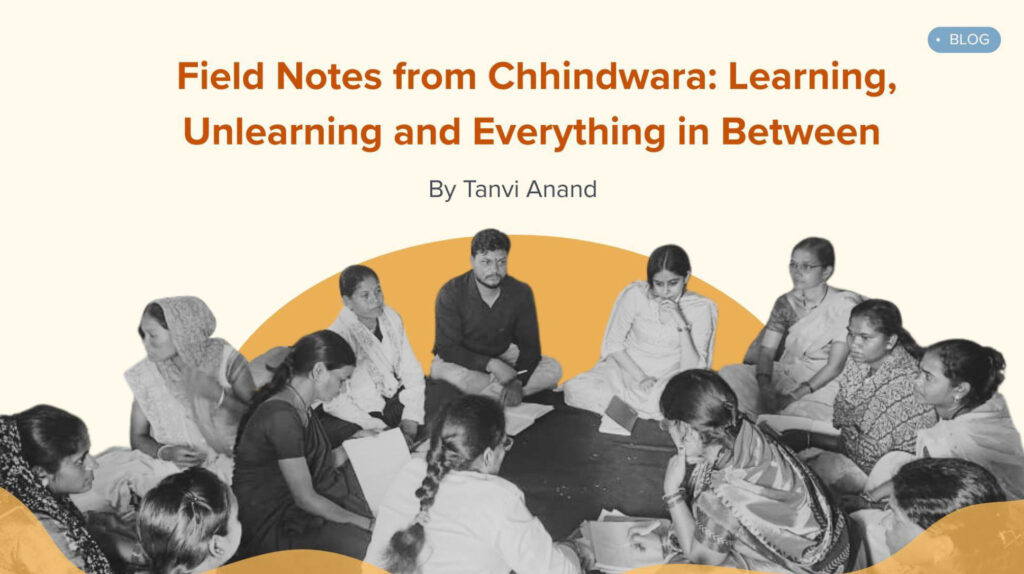
 Field Notes from Chhindwara: Learning, Unlearning and Everything in Between
I come from a city, and like many others, my master’s years were swept up in the uncertainty and confinement of COVID. Field visits, the kind that take you out of classrooms and into real communities, simply did not happen. It is only now, thanks to my work with The Antara Foundation (TAF), that I have begun to experience rural India firsthand. Each visit feels like entering into a new world: one that is humbling, overwhelming and full of unexpected insights.
My recent trip to Mohkhed block of Chhindwara district in Madhya Pradesh was no different. I attended two Participatory Learning and Action (PLA) meetings: one focused on care for at-risk newborns and the other on diarrhoea management. While I was there to observe, the sessions stirred more personal reflection than professional critique.
What is PLA (Participatory Learning and Action)?
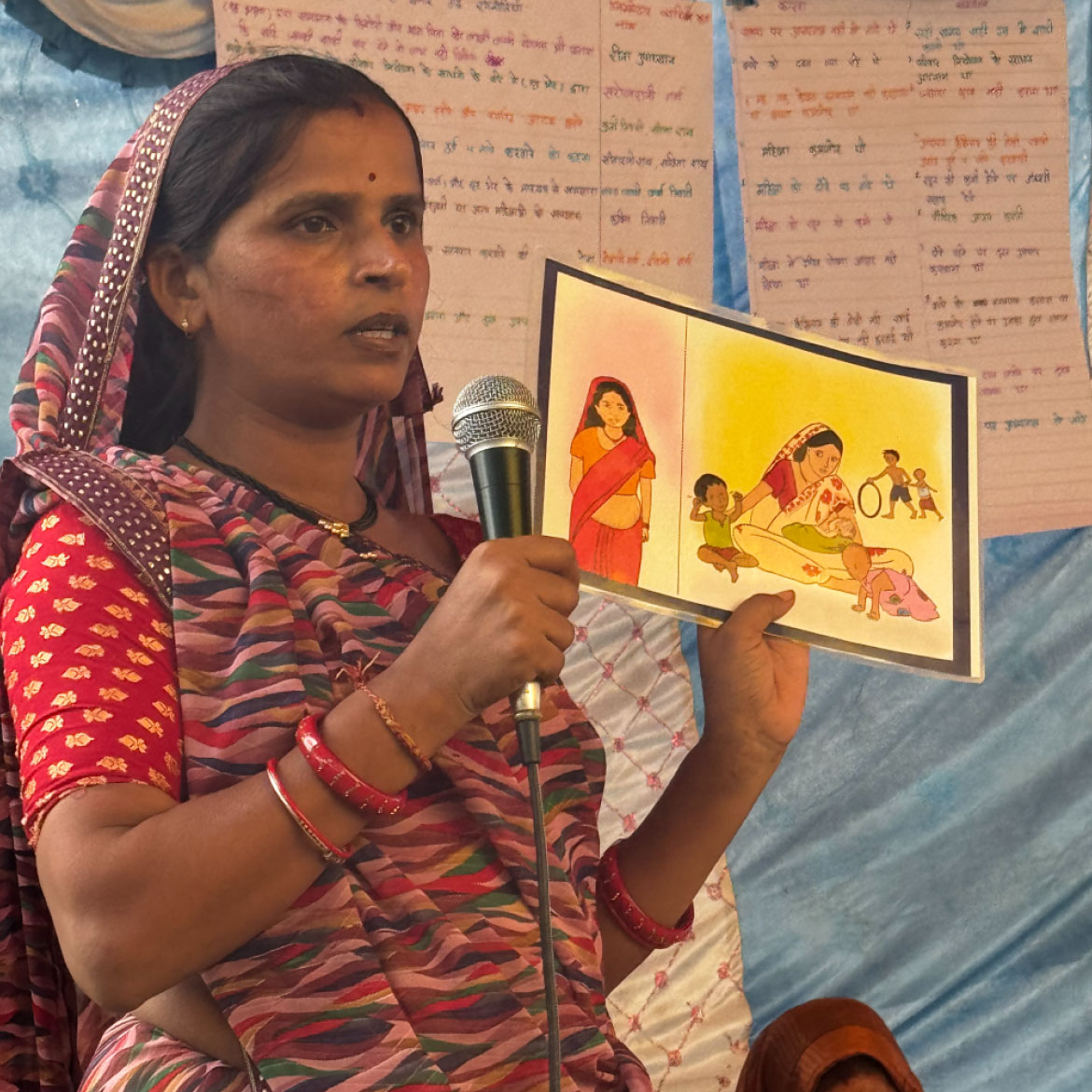
Participatory Learning and Action (PLA) meeting
PLA is a community-led approach used in health and development. Rather than one-way instruction, it centres on dialogue. Local people identify their challenges, share experiences, and work toward practical, collective solutions. It is not about delivering information but about enabling ownership and action.
During the first PLA meeting, we reached around 10:30 AM. This time maybe works well in city calendars, but not in rural ones. Many people had already left for the fi elds as it was a crucial agricultural period (‘khaad dal rahi hai’), and the rhythm of their day was shaped by that. Others were busy with household tasks. One woman said she could not attend because she still had to bathe. Another needed to cook for her in-laws.
The date of the meeting had been decided a month in advance in consultation with the community. But I found myself wondering: was the timing right? These conversations are important, but so is the everyday labour that sustains a household. Farming feeds the family. Chores are not shared equally. Should we persuade people more to attend? Should we adjust sessions to their schedules? Or simply accept that even health cannot always compete with more immediate needs? There are probably no easy answers; just an ongoing negotiation between good intentions, community buy-in, and lived priorities.
What stayed with me the most, though, was the quality of facilitation. Pramila Didi, who led the session, was calm, clear, and deeply engaging. I had come as an observer. But I found myself completely drawn in – listening, learning, and forgetting everything else.
As a general practice, every PLA session begins with a quick recap of the previous discussion, followed by introductions. The group had around 15–16 women that day. One older woman hesitated to say her name. “It is very old-fashioned,” she said quietly. The woman beside her responded with gentle confidence: “Mera naam? Sabko pata hai. Mera naam XXX hai.” She said it with such clarity that Pramila Didi asked the group to clap for her. We circled back to the shy woman hoping she would tell her name now, but she still did not.
I shared this incident later with a friend, who pointed out how common this is. In many villages, everyone already knows one another yet a woman’s name is rarely spoken aloud. Over time, women are referred to only through their relationships, as someone’s wife, someone’s mother, someone’s daughter-in-law. Their personal identity slowly fades from public life. It took me a while to truly absorb that probably because I had never looked at it as a problem, or even really noticed it for what it was.
A quick stat: According to NFHS-5 (2019–21), only 31% of currently married women in rural Madhya Pradesh have a say in all three key household decisions: health care, major purchases, and visits to family. In such a context, even a small act like stating one’s own name carries deeper meaning. It is not just about identity; it is about voice.
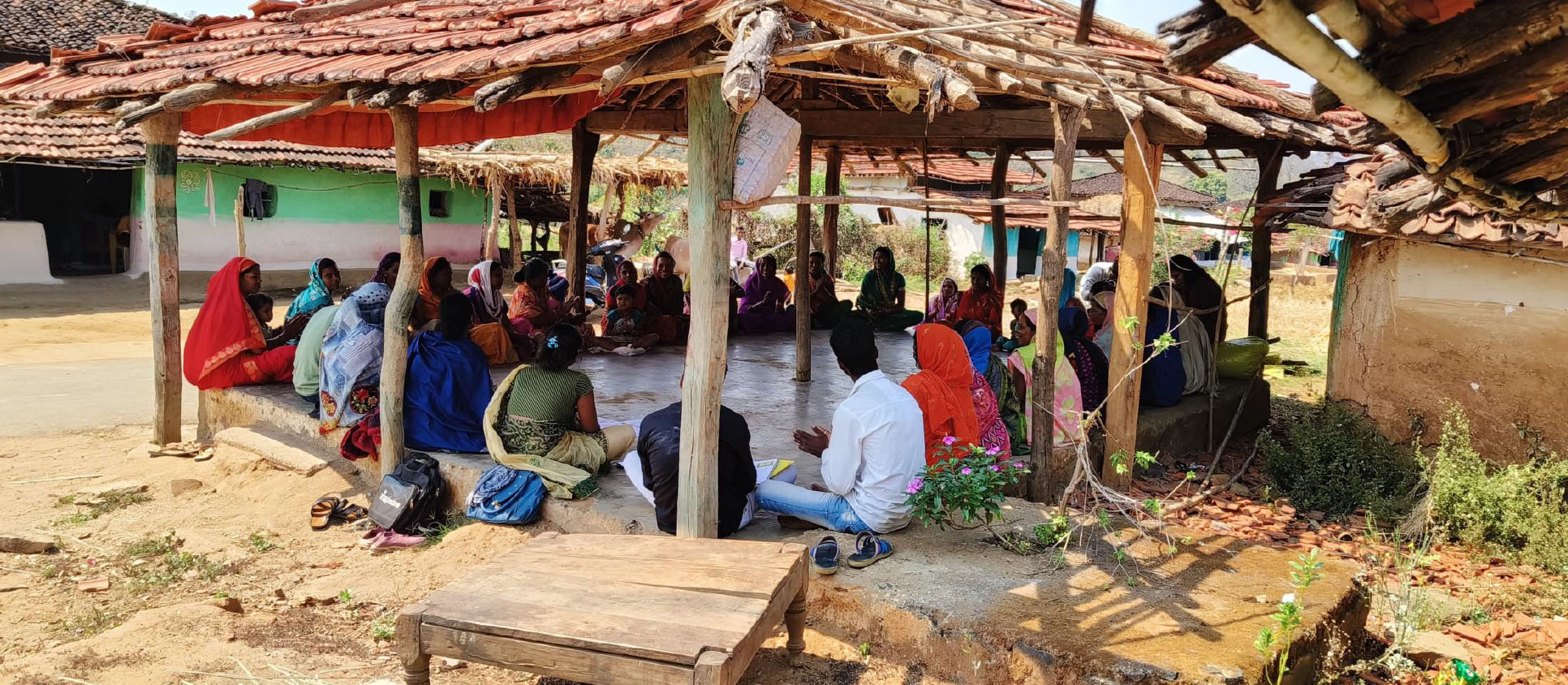
Participatory Learning and Action (PLA) meeting
Later in the session, one woman remarked:“Yaar yeh sab pehle kyu nahi bataya? My children have grown up now, but I wish I had known all this earlier.” Her words carried both regret and appreciation. It was a sign that the discussion had truly resonated. That is when Pramila Didi immediately stepped in: “It is not just for your own child,” she said. “It is for any child around you. If we know something helpful, we should look out for each other and share it, especially when someone needs it.”
In the diarrhoea management session, we talked about common triggers, handwashing and prevention. An elderly woman said softly, “During our time, there was no soap. Still, we were healthier. Now people fall sick more easily.” She paused. “Even cancer is so common these days.” Her observation reflected how perceptions of health are changing. It made me reflect that not everything has a simple answer. Are we healthier? Or are we just more aware? I don’t know. But the session sparked honest conversations, and even some unexpected engagement.
Interestingly, a group of young men had been standing around casually at the start of the session, cracking jokes and loitering nearby. But as the conversation progressed, they began listening, really listening. By the end, they were even responding to questions. While I was happy to see that, I also had a few thoughts in my mind: why do these sessions mostly attract women? These are community concerns, not just women’s issues. Yet the responsibility of showing up, of learning, of shifting behaviours, still rests largely on women. What might change if more men were encouraged to take part? What would it take for that shift to happen?
I also attended a Village Health, Sanitation and Nutrition Day (VHSND) meeting, which ended with a CAAA meeting. There is a new component that has been added to the conventional TAF’s AAA intervention named ‘Adopt a Bindi’. This is where TAF’s evolving community focus becomes evident.
What is the Adopt a Bindi?
As part of TAF’s AAA model, “Adopt a Bindi” is a community initiative introduced during village mapping. Coloured bindis are used to mark vulnerable individuals. Community members can voluntarily “adopt” a bindi, offering support to someone nearby, known them, or simply in need. It is a small symbolic gesture, but one that nurtures empathy, shared responsibility and local care.
At the VHSND, the auxiliary nurse-midwife gently examined a young woman who was nearing her second delivery. After noting that she was high-risk, the auxiliary nurse midwife asked softly, “Khaana theek se kha rahi ho?”. The woman’s eyes welled up with tears. She did not say much, but another woman sitting nearby explained her situation: her husband had been bedridden after an accident, her mother-in-law drank heavily, and most days, she barely managed two meals herself.
There was a brief pause. Then someone in the group quietly said, “If things continue like this at her home, I am ready to adopt her child. And if she is not comfortable with that, I will make sure the child gets two meals a day.” It was a simple and instinctive response, but it said so much about what care can look like.
What I am Taking Away
What Chhindwara offered me, more than insights or “learnings”, was a reminder that change does not always come in the form of new programs or perfect dashboards. Sometimes, it is a woman saying her name out loud. Sometimes, it is an anganwadi worker quietly making sure a child is fed. These moments, grounded in empathy rather than entitlement, are what hold communities together.
I am also beginning to see fi eld not just as a site of delivery, but of agency. The CAAA model, beyond its core objective, shows what empowerment can look like particularly when women support each other; when frontline workers step up not just as implementers, but as anchors of care. It is, in many ways, a great example of convergence: where systems, communities, and relationships come together to protect the most vulnerable.
There is a long way to go. But every visit like this reminds me that people, especially women, are not waiting passively for change. They are already doing the work and holding the fabric of public health together in their own steady, often invisible ways.
I don’t know if this counts as a proper public health blog. But I do know that this is what it feels like to be in the fi eld: equal parts humility, heartbreak and hope.
The least we can do is notice, listen and learn.