
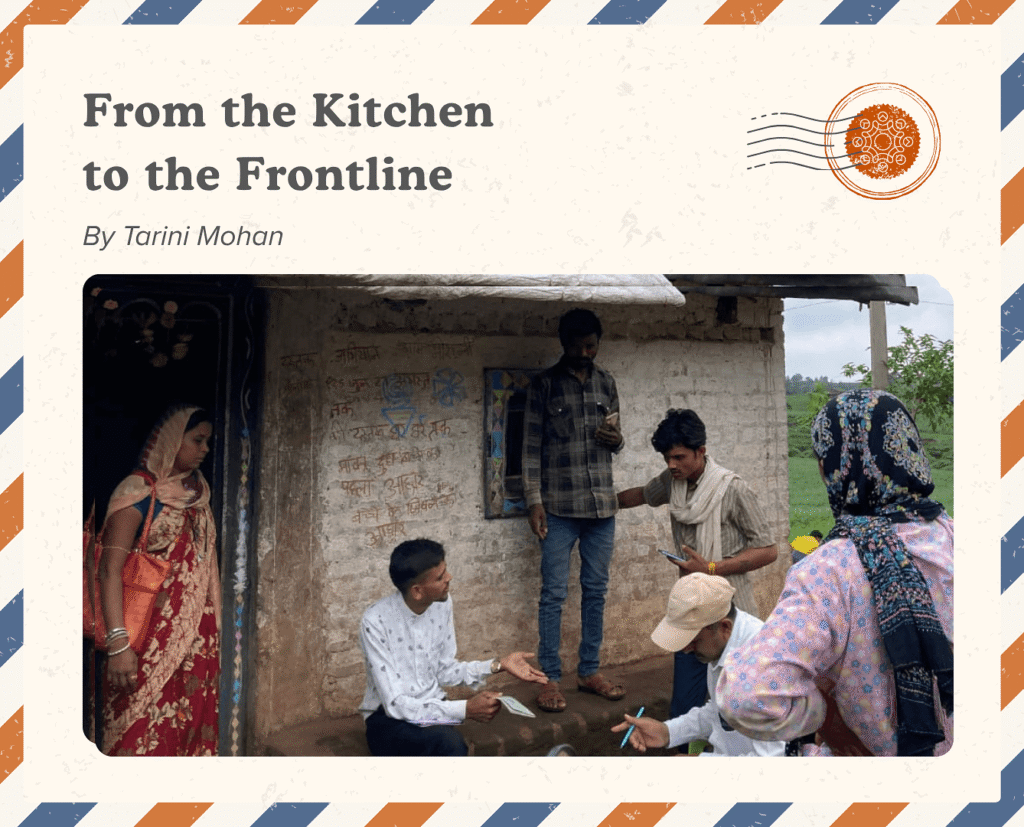
 From the Kitchen to the Frontline
It is 8 am, three hours since Siyaram Kharte started his day. He has already visited his fields to water the crops while waiting for the laborers to arrive. Now, ready for work, he searches for his bag under a pile of clothes. It does not contain too much, but what it holds connects the villages in a Central Indian block to the health system.
Just then, he remembers that his wife always hangs it behind the front door when he hears the pitter-patter of his three-year-old son. He turns to find his son has beaten him to it, small hands freshly washed, eyes on the bag. The boy does not say anything. He does not need to. He knows what the bag on the hook means. Papa is going to work.
Siyaram, twenty-eight, swings a leg over his motorbike and rides out onto a road that only a few can navigate. Somewhere amidst the hills, there is a family that has not yet agreed to something they need to agree to. The block officials know this. When no one else can get a family to say yes, they call Siyaram.
In the village in the hilly, tribal belt, where Siyaram grew up, his family needs no introduction. His grandfather, a tribal elder, was the village headman, a position that is passed down from father to son. When Siyaram’s grandfather died, his father stepped into the role. The headman is, in Siyaram’s words, “like a police officer for the village”— the first point of contact when disputes arise, the final authority when a decision is needed. In the village, this man is known as the Patel. Siyaram grew up watching his father wield that authority.
One of seven siblings, he also grew up watching what alcohol could do to a village: to the men who drank it, to the women they came back to. He was thirteen when he decided he wanted no part in it. When his friends started drinking, Siyaram would pick up his Casio piano and go outside to play instead.
At around fifteen, he went to his father with an idea: organize a Navratri Garba[1] carnival, invite the surrounding villages, and use it to raise awareness of the ills of alcohol. His father listened. The event drew over one lakh people to their village.
Standing before them, Siyaram addressed the issue. He was just a teenager, a boy of the village. He had no degree, no official title, no training. He just knew the hundred and seventeen families who lived there, knew his father, and that Navaratri was coming. Over the next four years, alcohol consumption in his village fell. By the time Siyaram left the village to find work, close to three hundred boys had cleared their Class 12 exams, a number he believes would look very different had the drinking gone unchecked.
When Siyaram was sixteen, his family’s good fortune ran dry as his eldest brother fell gravely ill. What followed was a six-month stay at a hospital in a neighboring state and a debt of seven lakhs. Siyaram’s education had been proceeding without incident. But now, in the final year of his schooling, it came to an abrupt halt. No discussion—only a natural decision. His brother slipped into a coma. Siyaram took it upon himself to stay beside him, along with his mother. “Saving my brother’s life was my top priority,” he says, matter-of-factly.
Six months later, his brother regained consciousness.
But someone had to earn, and Siyaram was the one who could. He learned to drive a four-wheeler. Then he got behind the wheel and went to work. He began by ferrying farm laborers across the villages around his, driving a Toofan vehicle. The work taught him what no classroom could—which winding road led where, the workings of the agricultural economy, how to read his village folk, who lived where. Who trusted whom. Who was outspoken. Reticent. And why.
Over the next several years, Siyaram landed one job after another, none planned, all necessary.
His family was debt-free within three years.
Then he moved into formal employment, first as an office boy at a private school in his district, then at an engineering company that worked on municipal sewage lines. Still unglamorous. Considerably duller. But more structured. He especially liked his salary. Then, as often happens in small towns, where everyone knows everyone, Siyaram found himself talking to The Antara Foundation’s (TAF’s) staff. TAF was a new public health organization that had just arrived in his district, with a straightforward problem: where to find office space? Siyaram knew someone who knew somewhere. Once found, TAF offered him a job to cook for the staff. There was just one problem: he did not know how to cook. In those early months, the kitchen smelled of trial and error.
Every morning, after serving tea and toast to the staff, Siyaram would sit among them to overhear and learn about the organization’s work. It was there that Piyush, one of TAF’s three Directors of Program, first noticed him. What Piyush saw was not a cook. The man stirring the daal[2] had spent years moving through every faliya[3] in the block, learning which roads turned to rivers in the monsoon, which families would open their doors to strangers and which would bolt them shut, and how to find an at-risk pregnant woman in a hamlet that appeared on no map.
Within a month, Siyaram graduated from the kitchen to the field.
It was then that he began to understand what his unlikely path had prepared him for. Not driving, cooking, or handling paperwork, but this: sitting across an Adivasi[4] family, speaking his mother tongue, eating the same food, celebrating the same festivals. In a region where outsiders are felt before they are seen, Siyaram was not one.
When he was twenty-six, on a sunny morning, Siyaram had just returned from watering his crops when he checked his schedule. As a field coordinator at TAF, he tracks ten high-risk pregnancies every month, ten women whose names, addresses, and due dates live in his phone, and, more reliably, in his head. Today, he was scheduled to visit one of them in a neighboring village, along with program officers Pratik and Ravi, to tell her about the ‘birth waiting room’—a facility where women in their final weeks can stay close to the hospital, ready for when labor begins. A routine visit, or so it seemed.
They heard her before they saw her. Not quite a scream. But a sound visceral enough to set alarm bells off in the three men. They stepped into the room to find the dai[5] already there. So was the baba[6]. The woman lay on a charpoy[7], writhing in pain, her hands clutching her belly, her face bearing unmistakable pain-etched lines. The dai said the baby was coming “ulta”[8]; feet first. The largest part of the baby, the head, was still inside. Siyaram’s eyes moved to the dai’s hands. She was holding a razor. A shudder coursed through his body. I’m glad we’re here now. He stepped closer to examine the woman.
Then Siyaram read the room. Who holds authority. Who is afraid. Are they open to advice? He took the near-hysterical husband aside and said, “Your child is stuck. The placenta is involved. This requires an operation.” The husband said nothing. He looked at his wife, then at the floor, then at Siyaram. Two decades of trying for a child pressed on him. And finally, he nodded.
The ambulance came. But with no stretcher. The four younger men present stepped outside and built one from what they could find in the courtyard. When they returned, the dai was still there, frozen, razor in hand, a pallor of white-hot worry. Before her, on the charpoy, the woman lay gasping for air between moans. The newborn baby, now out, oozed blood from his neck, where the razor had found it instead of the passage the dai intended to clear. She had done this many times before, she said, emphasizing the word many. It had always worked. This time, the baby had moved, or she had. She meant no harm. She meant the opposite. Then, the dai told them what they could already see: only half of the placenta had followed the baby; the other half was stuck inside. The woman was losing blood. The baby was losing blood. The room that had been alive with cries of pain fifteen minutes ago now felt as quiet as a cemetery.
Siyaram did not wait. They loaded the mother onto the stretcher, baby beside her, and hurried to the ambulance. The hospital saved the mother. The baby did not survive.
In the waiting room, Siyaram’s phone buzzed. Another village. Another family. Another woman whose name was on his list. He looked at the screen, then at the door behind which the mother was being helped. He had wanted to see her after—healthy, the worst behind her, maybe even holding the child he had not been able to save. That was, if he was honest with himself, the part of the work that kept him going back.
But he also understood what his training had taught him: that a public health worker who gets too close to the families he serves risks losing the very thing that makes him effective. Professional distance is not cold. It is, or so he had been told, a form of discipline. This principle of public health work is easier to believe than to put into practice.
He found the husband, looked into his eyes, and said, “Call me any time, for anything. I will come back to visit soon.” The husband nodded, eyes red. Siyaram put a hand on his shoulder, then stepped back, walked out of the hospital, got on his motorbike, and rode toward the next name on his list.
He never learned the baby’s name, if he even had one yet.
He had not gone far when his phone buzzed again. He pulled over. It was the husband—his voice more whimper than words, broken by loud sobs. It took a long time, he said, but his wife was safe. Then, he said something that kept Siyaram from holding on to that relief: “If you had only come a little earlier, my child could have also been saved.”
Fifteen days later, as promised, Siyaram returned with Ravi and Pratik to visit the family and interview the dai to learn the specifics of what happened that day.
The interview did not go as planned. The dai began by calmly explaining what had happened that day. Mid-sentence, something came over her. Her facial muscles grew rigid, her voice rose a register, and as if using her body as a weapon, she fell on top of a bewildered Pratik seated beside her. The room was small. A baba sat in the corner, a dai somewhere behind him, and four men, only one of whom was meant to be there. Siyaram stepped forward, not toward the dai, but close enough. He spoke to her softly in his dialect, praising her for all the babies she had delivered in the middle of the night, for all the families she had helped. It was not untrue. It was also the only way out. They left with everyone in one piece.
Over the months that followed, Siyaram came back. Not once, not twice, but four times. Not to confront, just to sit. To sip tea if offered, to trade stories in Barela, to make himself familiar, and, little by little, trusted. He understands why a family still turns to the baba before seeking formal medical help. The baba is from the neighborhood, a respected elder, and following his advice is a tradition older than any government scheme. The issue, as Siyaram sees it, is not faith. It is the order of care. People do not reject medicine; they just arrive at it later, sometimes too late. He eventually counseled the dai and convinced her to recommend the healthcare system to expectant mothers. Today, she calls the ambulance herself and carries the medical kit.
Siyaram does not claim this as a victory, but more as a method. And not a universal one. With babas and dais, he sits and compliments: “Thank you, you are doing the right thing, and going to the hospital is also the right thing.” Both can be true. With a father-in-law not used to having his authority questioned, he has directly said, “If you don’t want this child, take her to an orphanage.” It worked. He is not proud of it in the way you would expect, but he is not ashamed either.
He arrived at TAF, aged twenty-four, as a cook. Now, four years later, he holds regular meetings with government functionaries, from community-level workers up to the Block Medical Officer and the Child Development Protection Officer. He has bought a car, two tractors, and a DJ truck he has named Mahakaal DJ—speakers loaded on the back of a pickup, the words Adivasi King, adorning the front. During wedding season, it earns thirty thousand rupees a day. When he is tired or in a ratty mood, he picks up his Casio Piano and goes out to play. He has been doing this since he was a teenager. It is something that never needed explaining.
When the people of his village heard that Siyaram had flown to Delhi, the first among them to board a plane, they shared the news across Instagram and WhatsApp. He had been to Delhi once before, carrying papers for someone else. This time, he came as the chief guest.
He did not become a doctor. He did not sit for his Class 12 exams. Somewhere behind his front door, a bag hangs on a hook. His three-year-old son already knows what it means.
|
|
|
Tarini Mohan is a strategic advisor at The Antara Foundation (TAF) and the author of ‘Lifequake,’ published by Juggernaut Books in 2025.
Siyaram Kharte is a field coordinator at TAF. This story is based on an interview conducted in Hindi.
 Siyaram in conversation with community women and a child in a Central Indian village.
 Siyaram, leading a discussion with community members.