
 From a Village in West Bengal to Delhi, and Now, to Chhindwara
Nabomitro Narjinary is the only person from his village in Jalpaiguri, West Bengal, to have ever left it.
He grew up among a thousand people, most of them farmers. Today, he goes by Mitra ji at The Antara Foundation, where he works as a Senior Field Assistant in Chhindwara district, Madhya Pradesh. Though this wasn’t always the case.
After school, something in him outgrew the village fields. He told his family he wanted to leave not just his village but also his district. And if luck was on his side, the state borders, too. No one in his family had ever left their hamlet and couldn’t even imagine life outside it, but they didn’t hold him back. With his parents’ blessings, he applied for jobs beyond West Bengal and was offered a position at the Royal Bank of Scotland, in not just any bustling metropolis but in New Delhi. He took it.
Learning the ways of life in a chaotic big city wasn’t easy at first and kept him occupied…for a while. Then, three years on, he felt the same pull for change return. After all the effort he had invested in getting acquainted with life in Delhi, Mitra ji couldn’t bring himself to leave it just yet. He found work at the BBC in Delhi for another four years.
But Mitra ji just could not shake an ache that had, by now, settled deep into his bones. Since his youth, he had wanted to give back to his people; specifically, by helping improve the health and nutrition of the women he saw toiling in the fields all day. Instead, here he was, working far afield, at profit-making companies. But he didn’t linger on this nagging thought for long; instead, he met up with Reenu Uppal, a former colleague at RBS (acquired by ABN Amro) who had since become a founding member and Director of Operations at a small nonprofit called The Antara Foundation (TAF), working on maternal, newborn, child health and nutrition (MNCHN), largely for tribal women. She told him that TAF was looking for people.
For Mitra ji, it was almost too hard to resist. Almost.
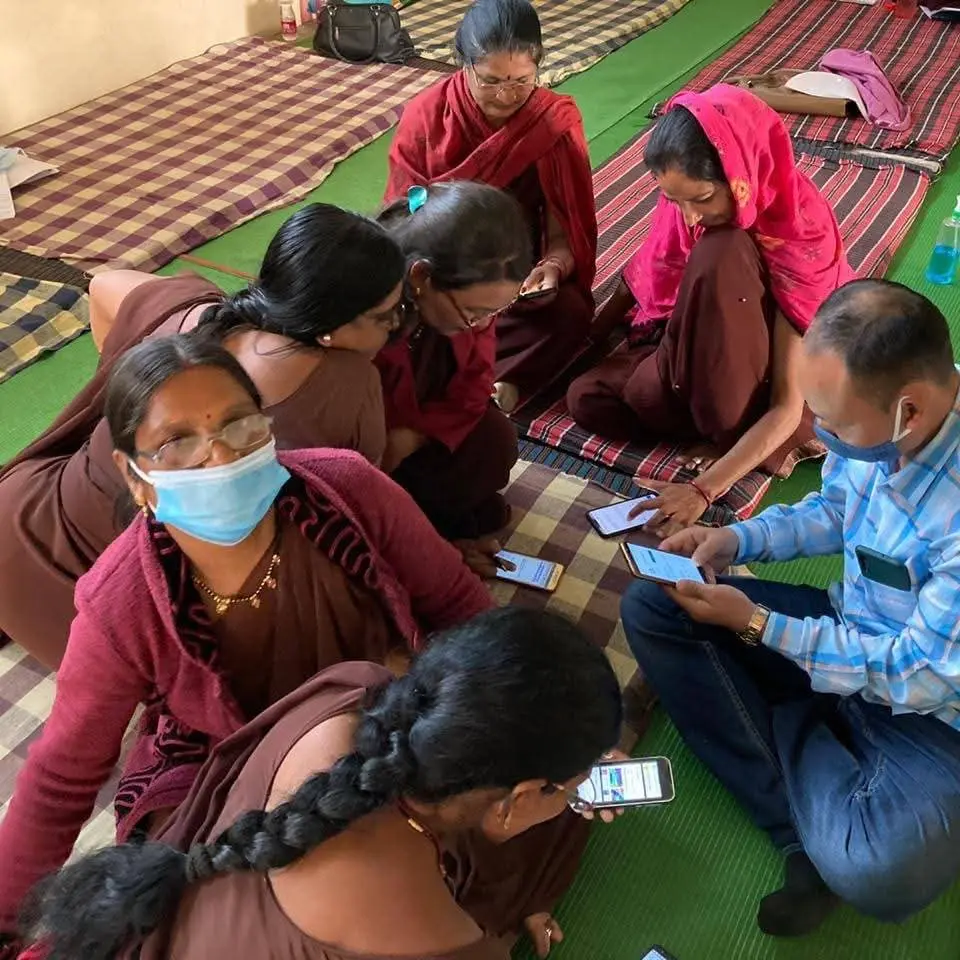
Mitra ji coaching frontline workers in 2020, on how to capture data from the field using ODK.
The Antara Foundation offered him a role that would require him to relocate to the office in Chhindwara district, Madhya Pradesh, away from the city he had made his home. But he wasn’t about to play with destiny. Instead, he decided to see what work at TAF was like by volunteering his time at the organization’s headquarters in Delhi as an office boy, offering administrative support. Before long, Mitra ji felt surrounded by his people–so much so that he continued this arrangement for five entire years. The natural next step was to make TAF his full-time home. He was prepared to relocate if it meant continuing with this organization, especially for work that helped improve MNCHN for isolated tribal women and their children. What he didn’t lead with, and what came up later, was that he is Adivasi himself, from the Boro, or Mech community, one of the oldest Scheduled Tribes, belonging to the Tibeto-Burman ethno-linguistic group. The health and nutrition of tribal women and children was, in part, his own story.
His first assignment in Chhindwara was data entry for the AAA platform, the network of Anganwadi workers, ASHAs, and ANMs that is the fulcrum of TAF’s work in villages. The meetings are held at the local Anganwadi Centers. One day, when Mitra ji arrived early for one such meeting, he learned that there was no such center in that particular village. No building, no room. He took it upon himself to explore the village until he found an empty courtyard, where the meeting took place instead.
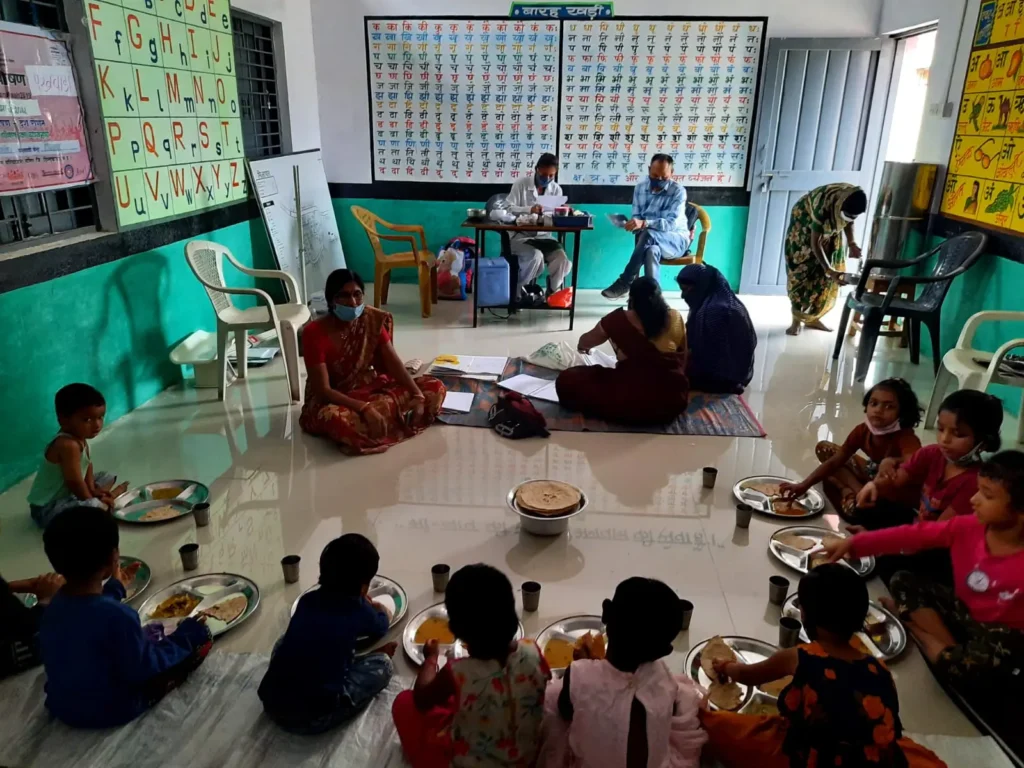
Mitra ji capturing data in an Anganwadi meeting.
Years later, as Senior Field Assistant for the Seoni and Chhindwara district offices, that same instinct, to find solutions to problems, has become part of his job description. He now sits on the Chhindwara office workplace culture committee, where colleagues describe him as the person who solves problems no one has been able to. When a group of donors returned from a field visit one afternoon, famished and with nothing available nearby, Mitra ji arranged for home-cooked food, made at the office, to be delivered to them. The donors didn’t forget it. He has worked in Chhindwara for six years now, handling admin and some finance work.
He speaks about the Chhindwara office with pride dripping from every word. He feels what sets his office apart is how much people look out for one another. He talks about it as a fact about the place.
Ask him what has left the biggest mark on him in almost a decade of his work at TAF, and he answers in a flash. It’s Prerna Gopal. Prerna was a program officer in Chhindwara who was the first person to take him to the villages where TAF worked, back when he was still new to the work. He has not forgotten experiencing firsthand what he had only heard about in theory. That first field visit is what changed his thinking and, not least, opened doors for him.