
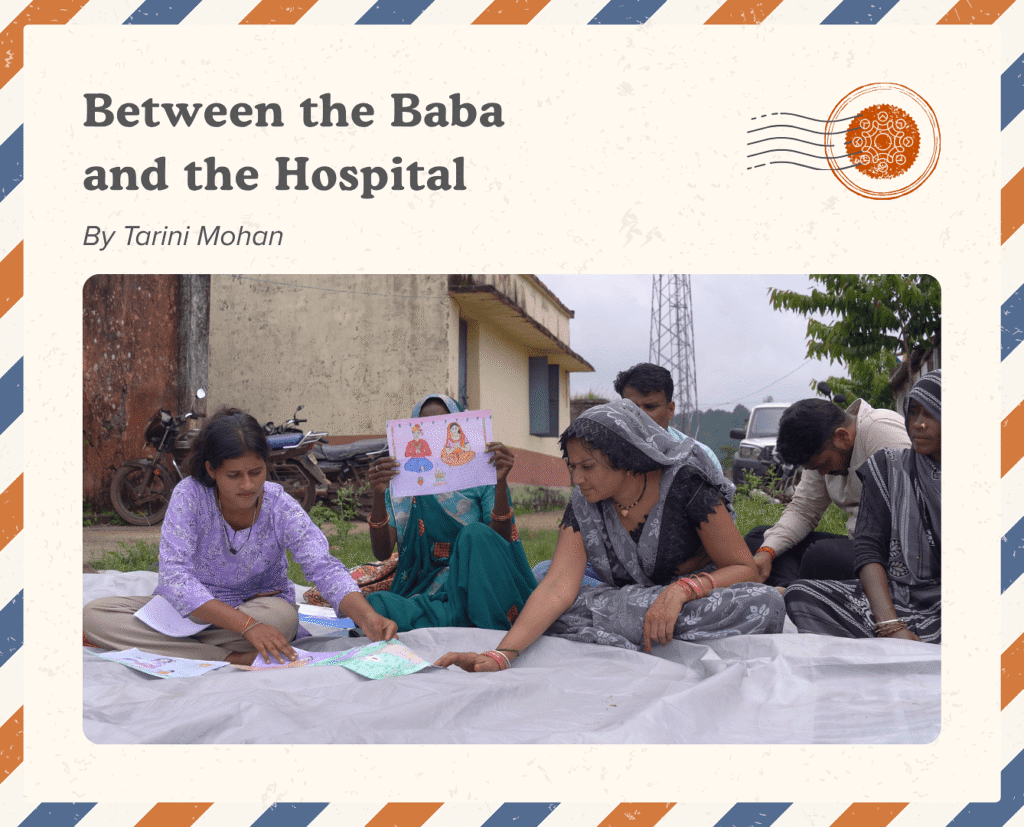
 Between the Baba and the Hospital
Laxmi Solanki weaved her two-wheeler through the rugged terrain of a Central Indian tribal district. She winced as the tires skidded over the jagged red rocks, her body jolting with each bump and turn. After a morning of this, Laxmi stopped the scooter to take a moment to absorb the familiar landscape before her. This was home.
Laxmi is 25 and from an Adivasi[1] community. The youngest of four siblings, she is the only one who stayed in school. Her brothers and sisters dropped out to marry, to earn, and do what was expected. They all grew up in a village in Central India. Her parents are farmers who wanted something different for their children, though what that looked like was not always clear or agreed upon. The clearest voice in that direction was Laxmi’s mother, who carried a specific regret: her own father, a village leader, had offered her an education, which she had refused. She did not want the same for her youngest.
To understand the cost of this choice, one must first understand what it means to be a member of Laxmi’s Adivasi community. Not simply tribal. Not simply a Scheduled Tribe entry in a government register. Hers is a distinct community, with its own logic of illness and healing, its own instincts about what a pregnant woman’s body needs, its own hierarchy of voices—who speaks, who must defer, who has the last word in a household. Laxmi grew up inside all of this. And she knows her community’s views on educating girls: that schooling makes them ‘difficult.’ That knowledge makes them likely to ‘misbehave.’
It is a wonder, then, that Laxmi’s parents made the choices they did. They sent her to school. They kept her there. They supported her through a master’s degree in social work. Traditional in their beliefs, yet, for reasons that seem to have more to do with love than custom, and with a mother’s unfinished business, they wanted their youngest to be different. To be self-sufficient. The phrase Laxmi returned to more than once is this: “Apne pair par khud khade ho.” Stand on your own feet. It is the instruction her parents gave her before she knew what it would demand from her, and it remains, she says, their greatest gift.
And stand on her own feet she did. After completing her schooling, Laxmi enrolled in a master’s program in social work in the district where she grew up, while working as a saleswoman for Hindustan Unilever. The neighbors noticed. They always do.
“First, you educate her, and now this?” they sneered at her parents. “What is a highly educated girl doing, selling products?”
Her parents did not flinch.
“What is it to you?” they replied. “Our daughter is standing on her own feet. She is not asking anyone for anything.”
It was her professor who first pointed her toward The Antara Foundation (TAF). He had come across a vacancy at what he called an “esteemed organization” and suggested she apply. She had never heard of TAF. She knew nothing of what the work would involve. She applied anyway, full of curiosity and hunger for something new.
The interview process had three stages. She cleared all of them.
What makes this unremarkable in one sense is everything in another. Laxmi had grown up in a world that taught women to make themselves small—to keep their heads down, to not speak unless spoken to, to believe ambition is something indecent. She had absorbed these messages as one absorbs faint but consistent voices heard every day. She had heard all of it. She just chose not to listen.
Choosing, though, is not the same as finding it easy. In her early days at TAF, the habits of a lifetime were difficult to shake off, especially with a new cohort of strangers. During meetings, she gravitated to the corner and kept her thoughts to herself, as if she were holding on to the belief that women who speak up invite trouble. Her supervisor was the first to nudge her out of it, telling her directly that asking questions was not just allowed but necessary—the only way she would learn and the only way the organization could benefit from her insights. Colleagues echoed the same. Slowly, then less slowly, Laxmi emerged. In the field, she never really had a shell. With the women she visits, conversation flows—on charpoys, outside anganwadis[2], walking between faliyas[3]. She asks about their children, their harvests, their mothers-in-law. They laugh. They chat. This is how Laxmi builds trust. Her supervisors have noticed and, while glad she connects so well, have occasionally suggested she try being a little more professional. She finds this difficult—especially among her people.
The work had its own answers to all of this. It kept her in her home district, in a region where 7 in 10 people are from the tribal community. She chose to learn to ride a scooter to visit the homes of women whom the system struggles to see.
Exhaling deeply, Laxmi dismounted from the scooter she had learned to drive for this work, having navigated narrow paths carved into a steep escarpment. Her white running shoes crunching over sunbaked pebbles, Laxmi looked up to see a thatched hut. She had finally arrived at Kalibai’s[4] home. The local ASHA, who was accompanying her, was right behind her and hung back by the doorway. Kalibai was a high-risk pregnant woman in her final trimester, whose case the ASHA alerts had flagged.
Inside the dim, earth-floored space, lit by slivers of sunlight piercing through the thatched roof, Kalibai sat cross-legged, nearly nine months heavy with her third child, on a charpoy. She was rubbing her swollen belly with a sweat-stained yellow sari pallu[5] draped over her upper torso. An aroma of drying red chilis wafted through the house. Her father-in-law, a wiry elder with betel-stained teeth and a lungi knotted at the waist, squatted near a clay chulha, stirring a pot of ragi porridge while insisting gruffly on a home birth.
“Our dai has delivered generations here, under these very hills.” His eyes followed his index finger to the Satpura Range outside the window before he went on, “There’s no need for city hospitals with their cold beds and aggressive ways. The spirits favor our ways.” With an air of finality, he resumed his stirring.
Laxmi perched gently on the edge of Kalibai’s charpoy, studying the woman’s Mother Child Protection card, the health passport used to track maternal and child health. Her brows knitted together. The danger signs were clear: high blood pressure and possible anemia, flagged in last week’s checkup.
“Bapuji, these gorges flood in the monsoon, turning paths into rivers, making it impossible to seek help, if needed. We are lucky that our district has a comprehensive emergency obstetric care ward with oxygen, blood, working hemoglobin monitors, and monitors to catch bleeding or other complications that our dai can’t fight alone.” Laxmi paused to study Bapuji’s face, still turned toward his stirring. She would have to toughen her stance. “Last month, in the neighboring block, we lost a strong mother like her to a hidden hemorrhage. I beg you, please don’t let pride steal a child from her arms.”
Kalibai clutched Laxmi’s hand tight and turned to Bapuji, her eyes cast down.
Bapuji looked at Kalibai. Then at Laxmi. Something sparked behind his eyes, not quite anger, not quite fear, and he shook his head once, slowly, and rose to his feet.
“Your dai can come with us, Bapuji. Let the hospital do what she cannot,” Laxmi said.
He paused. Then sat back down near the chulha.
“Why didn’t you say so sooner— that, I could consider,” Bapuji said. He filled a bowl with his steaming porridge, picked up another, filled it, and held it out. “Here, eat this. You must be hungry. I can only offer you porridge because my wife is away to fetch water from another mountain. Until yesterday, Kalibai was helping out with water duties, but today…”
“Thank you, Bapuji, your home will be blessed with a grandchild soon,” Laxmi said.
Laxmi accepted the bowl of porridge without hesitation. She said nothing about a heavily pregnant woman climbing a mountain for water. There would be a time and place for that conversation. Now was not that moment. She ate quickly, gratefully. The ASHA worker, who had accompanied her, was hovering nearby throughout and began cross-checking Kalibai’s records. Together, they spotted missing iron tablets and gaps in counseling. Laxmi pinged the WhatsApp War Room that TAF had set up to alert the Community Health Officer of the block to call for ambulances in emergencies. The rest was no longer in her hands. She sat up a little straighter, as if someone had lifted her spine.
Laxmi zipped down the winding ghat road from the district hospital on her way home. The air cooled her flushed cheeks, thick with the scent of rain-soaked earth and wild jamun berries tumbling roadside. Her heart swelled. Kalibai’s newborn daughter, plump and wailing triumphantly, was safe in her mother’s arms after a cesarean section caught a complication the dai could not have detected. The dai was doing her bit—she had brought freshly ground kohl with her to apply on the newborn’s eyes to ward off the evil eye, and insisted they press a heated coin on the baby’s raised navel to help it subside. Laxmi glanced at the heavens and let the dai have her moment.
Just then, she felt her phone buzz frantically in the pocket she had sewn onto her maroon kurta. She pulled over as soon as the road allowed. It was her parents. How strange, Mai and Dada never call me while I’m working. Her stomach clenched as she answered.
“Laxmi beta, come home as fast as you can. Your sister has been bitten by a snake.”
Laxmi almost fell off her scooter.
“But no need to panic, we’re rushing her to the Baba near the Narmada bend. She will be healed by the time you are back…God willing,” her mother added.
Laxmi leaned low over the handlebars and rode.
She arrived home to find no one there. The wind billowed through the open kitchen door; her mother had obviously left in a hurry. Then, she heard footsteps. She spun around to see her sister, limping, leaning on her father, her face contorting in pain.
Back from the Baba, and her sister was still unhealed despite her mother’s promise. Laxmi pleaded. She knew what a snakebite could do, how fast venom moved, and how little time they had. Laxmi reached for all the right words in her new public health vocabulary—the same words she used in strangers’ homes. Now she had to speak to her own family in “beneficiary-speak,” and that, too, in her own house.
But Laxmi’s public health-speak came too late. Well-meaning words are no match for the speed of venom. By the time they reached the hospital, it was already too late.
Laxmi does not speak about this easily. What stayed with her is not just the grief—that, she lives with every day—but the endless replays of what-ifs and could-haves in her mind. What if she had been home that afternoon? What if she had come home sooner? What if the hospital had felt like a place her family could trust more than the Baba by the river? She will never know which of these needed a different answer than reality, for her sister to still be here. She cannot possibly know if anything could have led to a different outcome. But it is that not-knowing that sparked a quiet revolution in how Laxmi thinks about her work and her life.
Before, public health was her profession. After her sister, it became something harder to name, harder to articulate, something like a stone in her chest and a promise at the same time.
Several months later, during a routine visit to a new mother, cradling her 3-day-old baby, Laxmi noticed the woman wincing each time she shifted her weight on the charpoy, toes curled tight, her jaw clenched. Laxmi gently lifted her sari to see an angry, swollen red ridge on her ankle, with a faint mark in its center, a telltale sign of a scorpion sting spreading up her leg. The family, Laxmi only now noticed, was preparing for an excursion to a Baba. Laxmi intervened, speaking in a calm, careful voice, one she had learned to use in situations where the wrong words could close crucial doors. The family agreed. They went to the hospital. The woman survived.
Laxmi did not celebrate. She went home, and thought about her sister, and then got back on her scooter.
The hills of her district do not offer any conclusions; they only offer roads carved into rocks to the next faliyas, to women whose names are not yet in any maternal health government registers. Laxmi knows this. Her white shoes will crunch over sunbaked pebbles, her phone inside the sewn-in pocket of her kurta. She will eat whatever is offered. She will likely talk too much and mean every word. She will know when to hold her tongue. She will carry her sister with her, as she always does, and will get back on her scooter. Apne pair par khud khade ho.
Tarini Mohan is a Strategic Advisor at The Antara Foundation (TAF) and the author of ‘Lifequake,’ published by Juggernaut Books in 2025.
Laxmi Solanki is a field coordinator at TAF. This story is based on an interview conducted in Hindi in New Delhi.