
 FC story Giyan
Educated Against the Odds, He Chose Not to Leave His People Behind
Giyan More swerved into the car park and looked up at the bright red letters of the private hospital he had come to that Saturday morning. He was not supposed to be here, especially not on a weekend, but had come to check on an important case: a pregnant tribal woman whose baby had died in the womb and who was now undergoing a C-section. While his volunteer spoke to the staff at the entrance, Giyan stepped outside for a minute.
In the car park, he noticed a crowd gathered around a vehicle. Men stood in a circle, taking turns to peer through, foreheads creased. A few younger ones held up their phones.
Giyan stopped.
He moved toward the car, edged through, and looked inside. In the back seat, a woman sat very still. Two small children, perhaps two and four, pressed against the doors, clawing at the windows, and crying. Across her lap lay a man, unconscious. Giyan turned to signal to his colleague, Dilip.
With Dilip at his side, he asked the woman to roll down the window. She said the hospital could not help, had directed them to a facility in Indore, and sent them back outside. She had no money and was waiting for relatives to drive them. Her husband had been unwell for days before she brought him in, and now she was stuck in the car park with two frantic children, not knowing what to do.
Giyan asked if they had documents. They had their Aadhaar and Ayushman cards. He told them about another hospital nearby with a better reputation that accepted Ayushman cards. When she hesitated, he offered to take them himself and help get her husband admitted. Dilip would make sure their relatives followed.
They went.
At the second hospital, a doctor examined the man and pronounced him dead—for days.
Giyan stayed with the family afterward. The grief that had just arrived had no shape yet. He had come to help, but had arrived too late, when nothing more could be done. He stayed anyway.
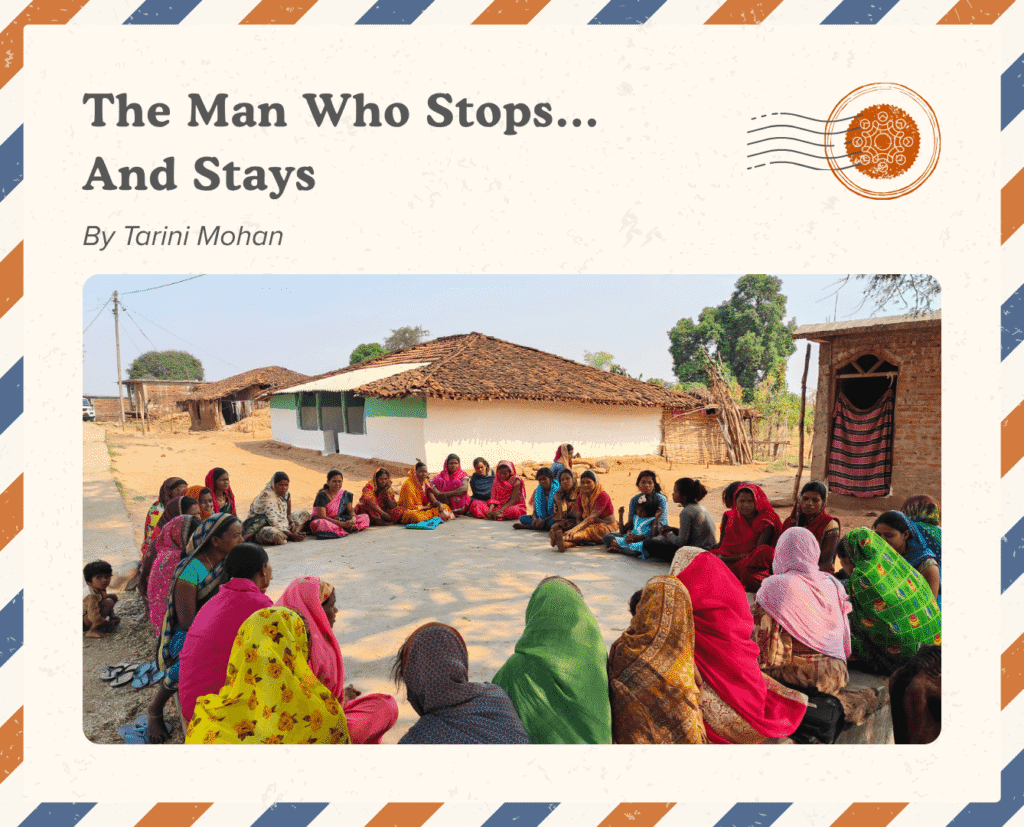
Shastra Faliya[1] is a hamlet of twenty-five houses on a flat stretch of land in Swarup village[2], in a Central Indian district. The region is mostly hills and forests, making the flatness a welcome surprise. Giyan More grew up here. He is the only person to have ever held a job in this hamlet.
His mother sent him and his three siblings to ‘school’ in a neighboring house, where a government teacher from another village came every other day. The teacher himself had only a school certificate. By the time Giyan reached class six, he and his siblings had ‘graduated’ to a real school in Kendriya[3] village, four kilometers away, near the Maharashtra border. Flat land or not, getting there was not easy. When the water was low, the children waded across a river, holding their books and clothes on their heads, and dressed on the other side. When it flooded, they took a longer route that took an hour and a half. Sometimes they could not go at all. Giyan made this crossing every day at low tide, from class six to eight. The girls studied until class eight and then married. The boys completed their schooling before settling down.
Not Giyan.
He chose to pursue a master’s in social work. While enrolled, he earned pocket money from odd jobs, such as picking lemons and other fruit. For his master’s, his parents borrowed Rs. 3,500 from a moneylender, secured only by goodwill and his father’s reputation; there was no jewelry to use as collateral. Giyan paid back the debt in installments by holding up lights at wedding processions late into the night, serving dal baati[4] at a dhaba[5], and distributing pamphlets for new real estate projects. It all accumulated. He missed classes when he had to and returned to his book in the gaps, studying for the exams that would decide what came next.
In the hostel, the rule was to speak only Hindi. At seventeen, Giyan’s mother tongue was still his tribal dialect, and the rule felt arcane. Now, at thirty-one, he uses Hindi to speak with government officials, auxiliary nurse-midwives, or ANMs for short, medical officers, and the families of women who fear what the hospital will do to them. He has never stopped using the language he was once forced to learn.
Before his MSW, he spent eight months coaching for a police exam in a nearby city, which he missed by seven marks. Then came network marketing and Axis Bank loan recovery, neither of which fit. Then came an agriculture NGO in Pati, a vaccination project that was shut down across the district. But Giyan kept going. After his MSW, one day, he got a call from an unknown number asking him to come in for an interview he had stopped expecting.
Onwards, he drove.
Giyan sends his daily plan to his team by 7:30 every morning. He eats a full meal before leaving, because he refuses to carry lunch into the field. On his phone, he keeps a private archive of the cases he counsels and the women he meets so he will not forget them. The archive is full.
His work is not as dramatic as people imagine fieldwork to be. Most of it is movement and conversation. A community volunteer meeting in one faliya, a group discussion in another, a visit with the ASHA worker to a woman who has stopped answering calls. The wins are slow. Fortunately, so are the losses.
|
|
|
One afternoon at the sub-health center in Dharam Ghati,[6] Giyan was reviewing a list of high-risk pregnancies with a local volunteer when the volunteer phoned one of the names—a woman from his hamlet. The call told him what he needed to know: a baba was already there, attempting the delivery himself. Giyan, the volunteer, and an ASHA worker left immediately.
Outside the house, a man holding court proclaimed that the baba was highly skilled and could remove a baby from the womb by hand if needed. Giyan stepped forward to speak to the woman’s young husband, who was listening. Then he addressed the baba directly, citing cases the community already knew about and describing what had gone wrong when families refused to go to the hospital, making the consequences clear. The baba stepped back.
The 108 ambulance would take two hours. A second service was unavailable. The village ambulance had no driver. The sarpanch arranged an auto rickshaw. The woman reached the Primary Health Centre in Kansari[7] and delivered a healthy baby within the hour.
Not every case ends this way. In the village of Kusum[8], a pregnant woman and her husband, both with severe sickle cell anemia, could not make a decision. Giyan visited with the ASHA and the ANM more than once. The husband did not agree. Eventually, a letter was signed stating the family had been repeatedly counseled and was refusing care. The visits stopped. She delivered at home.
There are times he steps forward without luck on his side. He has learned to keep trying.
Hearing the name of his district, Giyan thinks of her first.
A woman in her seventh month. Her sixth child on the way.
He found her not through a map, but on a flickering line on a government records screen. Her name was an oft-repeated entry in the logs, and the ANM confirmed she had delivered at home before, and before that, and before that. Giyan, along with Abhishek, his colleague, an ASHA worker, and an ASHA supervisor, visited her house in the Jamjariya[9] sub-center, the neighborhood where the rate of home deliveries had reached a tipping point that year.
What they saw in that house has stayed with him since. Five children, four girls and one boy, all close in age, in thin clothes, crouched on the earthen floor, eating small pieces of dry roti. The house had a spartan look—no proper utensils, no storage of grains, no lentils. Only a low mud hearth, shaped by hand, meant to hold a small fire fed with pieces of wood, and a lone, empty pot sitting on top.
She had swollen feet and complained of dizzy spells. Her husband, a daily wage earner, spent all his earnings on alcohol and refused to let her go to the hospital. She and her husband were migrants with no Aadhaar cards. She was an apparition, with no trace in any government record.
She said she wanted to go for a checkup but could not go alone. Her five children needed her.
Giyan and the ASHA supervisor spoke to her at length in their tribal dialect, the only language she understood. They could not speak to the husband because he would return late, in an inebriated state. The ASHA supervisor made the decision on his behalf: she would pay the auto fare herself. Next, she arranged for the only relative in the area to agree to watch the children for a few hours.
The next day, the ASHA worker accompanied the woman to a government hospital in Mandawad[10]. She was found to be severely anemic. However, the hospital could not arrange the iron sucrose injections that day, and she was told to return. Given the difficulty of her first visit, a second visit did not happen. But one visit itself was not nothing. She received iron-folic acid tablets, a physical exam, and instructions to eat three times a day, whatever food the house had. The dizzy spells stopped. She grew a little stronger.
The tracking continued as the months stretched on. Then, one night when her husband was away, and her children lost to sleep, she went into labor. Her house was isolated. At three in the morning, she gave birth to a baby boy, entirely alone.
When Giyan and team found out, they paid her a visit. They found her cradling her baby, wearing a wide smile.
But it was not all flowers and sunshine.
The birth dose—the vaccinations meant for the first twenty-four hours of life, for tuberculosis, Hepatitis B, and Polio, was not administered. Had anything gone fatally wrong with that delivery, there would be no record of one death, much less two. Not of anyone trying to help, either.
But people had tried. Every nodule of the system had reached toward her—the tracker, the ASHA, the ASHA supervisor, the one hospital visit, Giyan. The nodules stopped just short of the house that stood alone, appearing on no official map, where a woman with no documents, no permission, gave birth alone, in the dark.
He thinks of her first. He does not need to explain why.
That evening, after Jamjariya, Giyan drove to Abhishek’s house. Abhishek is his closest colleague, someone who has sat beside him at enough difficult bedsides and enough community meetings to know that not every day can be weathered alone. They had not planned to meet. Giyan felt no need to announce his arrival. One of them would just show up at the other’s door, and the door would open.
Eventually, Abhishek placed a large pot of mutton curry on the table. It is both men’s favorite dish, a fact they take some pride in, as though good taste in food proves good judgment in everything else. They ate. They talked about the case, then talked around it, then stopped talking about it altogether. At some point, someone made a small, slightly absurd joke, and both men laughed. Neither would remember exactly what was said. What they would remember is that they laughed, which is its own kind of medicine. The camaraderie that makes them good company at the dinner table also helps them work well together during home visits, community meetings, office meetings, and more. Both men have the ability to hold a heavy, hard thing, set it down briefly, and pick it up again without losing their nerve. Some mornings, they drive to the same sub-center together. Some evenings, they end up at the same table. Both things help.
Giyan’s archive keeps growing. Story after story, saved on his phone so they do not fall through the cracks. He still drives the uneven, unmapped roads of the district, knowing that for every woman who reaches a clinic, another remains out of reach.
Some of them, unlisted in any record, will not exist for the system. At home, they may be just another pair of hands. But for Giyan, they are not invisible. They are the measure of how far there still is to go. That is why he stops and stays. Because even when the system cannot reach everyone, he knows he can still try.
Between meetings, between home visits, between the names on his lists, these stories continue to hum at the back of his mind. Stories of isolated women who give birth in darkness, of names that never made it into the system, of women who reach care too late or not at all, of families who refuse institutional care despite counseling. Giyan keeps his archive full so that their names and faces do not fade into the dust. The stories of their resilience remain with him, spirits and survivors alike. He does not let the world look away.
Tarini Mohan is a strategic advisor at The Antara Foundation (TAF) and the author of ‘Lifequake,’ published by Juggernaut Books in 2025.
Giyan More is a field coordinator at TAF. This story is based on an interview conducted in Hindi.
 Figure 1 & 2: Giyan leading a community meeting at a faliya.
 Figure 3: Giyan conducting a home visit.