 Evidence is Better Understood Together_Feature image
When Rumaan first spoke to his parents about his work, monitoring and evaluation was a relatively unfamiliar field to them. To make it more relatable, he drew on the example of a well-known government program, the Swachh Bharat Abhiyan.
“Someone has to check whether a program is working and tell the people in charge what to change,” he patiently told his parents.
Rumaan works in monitoring and evaluation (M&E) at The Antara Foundation (TAF), and that “someone” is him, but for health programs.
He monitors TAF’s health programs and looks for lessons learned. His work spans program monitoring, data analysis and interpretation, and research and evaluation. He develops monitoring frameworks, analyses program data, reviews research methodologies and findings, and coordinates with external research agencies to support evidence generation and program learning. He is the point of contact for two impact evaluations. Alongside colleagues and developers, he has significantly contributed to towards creating monitoring frameworks and TAF’s centralized database management, Aalekha.
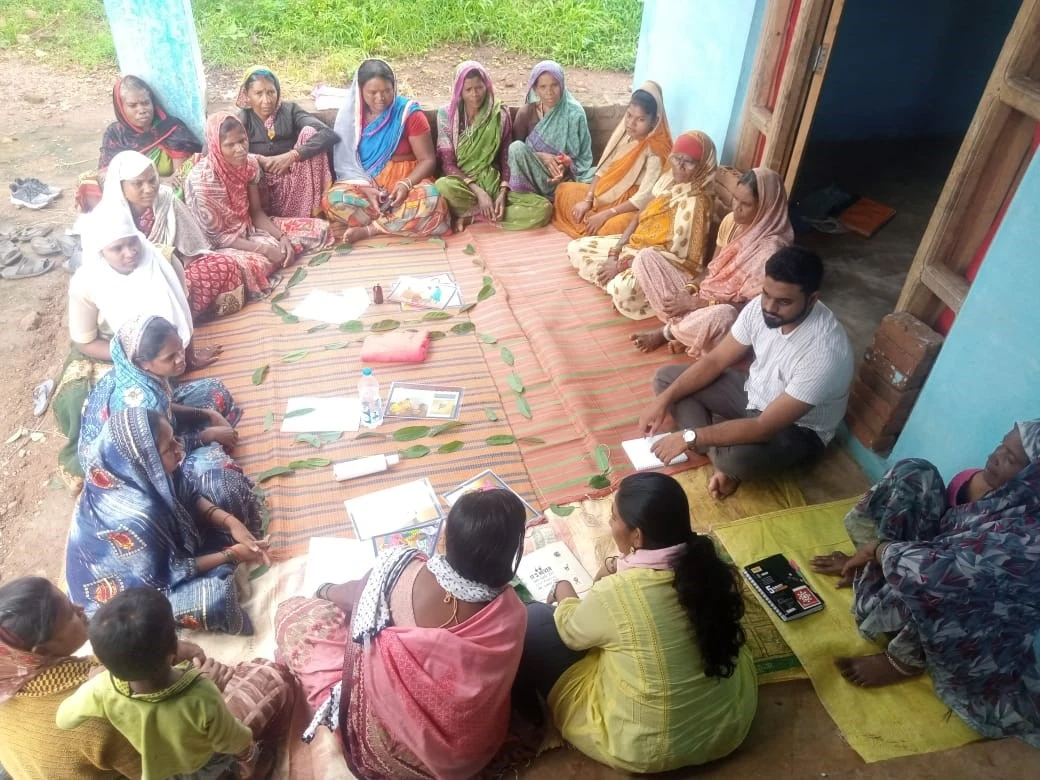
During a field visit
Rumaan grew up in Lohardaga, a bauxite-mining town in Jharkhand, and was the first in his family to complete higher education. Studying geography at Aligarh Muslim University sparked an interest in human geography, particularly population geography and demography. For his MA-MSc in Population Studies at IIPS, Mumbai, he used National Family Health Survey data to study infertility and nutrition for his dissertation. However, his fieldwork on tuberculosis in Mumbai’s Mankhurd drew him to public health.
People often equate M&E with data and accountability. Rumaan puts ‘learning’ on the same footing. When a program hits a hiccup, he checks whether it was implemented as planned and reached the people it was meant to reach. When it succeeds, he wants to understand why so he can share the lesson with the outside world.
He led and strengthened the monitoring system for one of TAF’s key community interventions, Participatory Learning and Action. The dashboard lets the team track coverage, spot gaps, and plan follow-ups in one place.
M&E means looking beyond implementation progress to understand what the evidence says about program outcomes. Process data shows whether activities are happening as intended, while outcome indicators offer a broader picture of change over time. Reading the two together requires attention to differences in reporting periods, definitions, and coverage, as well as the wider context in which programs operate.
This is where evaluations come in, helping teams assess whether the observed changes are indeed associated with the program. Randomized controlled trials are one rigorous way to estimate a program’s causal effects, but they aren’t always feasible or appropriate. In such cases, quasi-experimental designs offer another way to examine program impact. Rumaan works with government and internal program data to understand trends and works with external agencies to support evaluations. Throughout, he remains mindful that conclusions depend on the study design, available data, and assumptions underlying the analysis.
Rumaan sees his role as a bridge between what teams intend and what happens on the ground. While frontline teams have a rich understanding of what is happening, data brings their observations together, so patterns emerge across blocks and districts.
“The purpose is not to produce more data—it is to help people see the work more clearly and make better decisions because of what they see,” he says.